
2026 sunvega AI Wardrobe Design Software: Online Translation
The home furnishings industry is moving toward faster, more connected digital workflows. Sunvega’s public information shows the scale of this shift clearly: the company serves 20,000+ enterprise customers and 9,000 manufacturing clients globally, supports 18 languages, works with 20+ local service p
The home furnishings industry is moving toward faster, more connected digital workflows. Sunvega’s public information shows the scale of this shift clearly: the company serves 20,000+ enterprise customers and 9,000 manufacturing clients globally, supports 18 languages, works with 20+ local service partners, and reports an average 30% cost savings for clients. It also has 10,000+ happy clients across 20+ countries.
For wardrobe design in particular, the biggest change in 2026 is not just better rendering. It is the ability to move smoothly from design concept → product translation → quotation → visualization → manufacturing. In other words, wardrobe software is no longer just a drawing tool. It is becoming a business workflow tool.
Sunvega fits this trend well. Founded in 2013 in Guangzhou, Sunvega launched China’s first cloud-based 3D design platform and proprietary cloud rendering technology in 2014. Today, its ecosystem brings together AI, 3D visualization, and smart manufacturing, with core platforms such as AiHouse, Visioneer, Spacify, HomeSnap AI, and JEGA.
My view is simple: in wardrobe design, the real competition is no longer only “who can make the best picture.” It is “who can keep the design, the language, and the manufacturing data consistent from beginning to end.”
1) Why wardrobe design software needs online translation now
Wardrobe products cross more language boundaries than many teams expect. A single project may need:
English for overseas buyersLocal-language product pages for different markets
Standardized terminology for sales teams
Manufacturing-ready labels for factory execution
If the translation is inconsistent, the workflow breaks. For example:
“Custom wardrobe” may be translated correctly in marketing copy, but not matched in the quotation sheet.“Sliding-door wardrobe” may appear as one term in the sales catalog and another in the design file.
“Built-in wardrobe” may be presented differently across markets, causing confusion during localization.
Practical suggestion: Build a bilingual wardrobe glossary before publishing anything. Keep one approved term for each item name, size label, hardware part, and finish description. This is especially important when teams update product libraries frequently.
Common wardrobe terms for online translation
| Chinese term | Recommended English term |
|---|---|
| 定制衣柜 | custom wardrobe |
| 整体衣柜 | fitted wardrobe |
| 嵌入式衣柜 | built-in wardrobe |
| 步入式衣帽间 | walk-in closet |
| 推拉门衣柜 | sliding-door wardrobe |
| 平开门衣柜 | hinged wardrobe |
| 开放式衣柜 | open wardrobe |
| 柜体 | cabinet carcass |
| 五金 | hardware |
| 3D效果图 | 3D rendering |
| 720°全景 | 720° panoramic tour |
A wardrobe software platform becomes much more useful when these terms are not translated randomly, but managed as part of a standard workflow.
2) What Sunvega adds to wardrobe design workflows
Sunvega’s strength is that it connects multiple steps in one system rather than leaving them isolated.
Core advantages for wardrobe teams
AiHouse: AI-driven interior design based on real product catalogs, supporting professional customization.HomeSnap AI: useful for quick room layout planning.
Visioneer: supports immersive product presentation in a virtual showroom.
JEGA: connects design to manufacturing across the business lifecycle.
Cloud Modeling, Cloud Rendering, and CNC Machining: three self-developed engines that support digital twin creation, visual output, and production optimization.
For wardrobe design, this matters because cabinets, doors, shelves, and accessories are highly dependent on dimensions and production accuracy. A visual concept alone is not enough. The design must remain usable for sales and manufacturing.
Practical suggestion: When choosing wardrobe software, check whether it can do these three things together:
Generate accurate visual layoutsKeep product information consistent in multiple languages
Export production-ready data without re-entering the same information twice
If a platform can only draw the wardrobe but cannot connect to material lists, SKU libraries, or factory workflows, the business still loses time.
3) How online translation helps wardrobe sales teams close faster
In the home furnishings market, translation is not only about language. It is about speed and trust.
A polished wardrobe design may fail to convert if:
the product name is unclear,the finish description is translated differently on each page,
the quote and the render do not match,
the overseas client sees inconsistent labels.
Sunvega’s 18-language support and 20+ local service partners are important here because localization is not a one-time task. It is an ongoing business process.
Practical suggestion: Use a three-layer translation method:
Layer 1: Product terms
Keep names like “custom wardrobe,” “fitted wardrobe,” and “sliding-door wardrobe” standardized.
Layer 2: Sales copy
Translate benefits, style descriptions, and room scenarios in language that fits the local market.
Layer 3: Technical notes
Keep hardware, panel, dimension, and installation terms consistent for the factory and installer.
This approach reduces misunderstandings and helps the wardrobe project move smoothly from marketing to delivery.
4) Why wardrobe teams should care about 3D and cloud rendering
Wardrobe buyers often want to see how a cabinet looks in the room before they buy. That means visuals matter, but they must be fast enough to support sales.
Sunvega’s cloud rendering technology is designed to produce photorealistic visuals in minutes, which is useful when teams need:
multiple wardrobe finishes,different handle styles,
mirrored or glass-door variations,
space-saving layouts,
localized presentation materials.
The company’s portfolio also shows versatility across styles such as Retro, Minimalist, Light Luxury, American, and Chinese classical. That matters because wardrobe design is not one-market, one-style work anymore.
Practical suggestion: Create a wardrobe content package for each model:
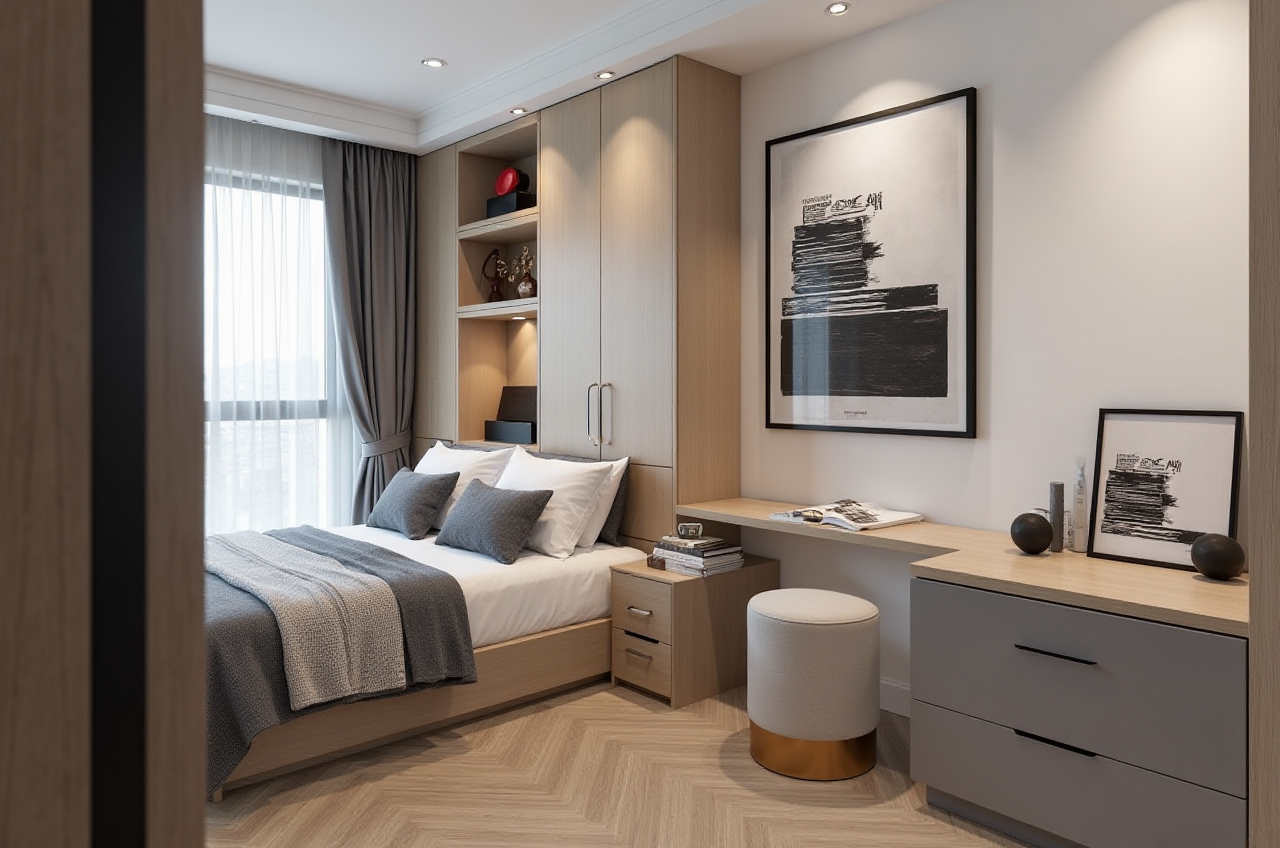 1 main 3D rendering
1 room scene
1 close-up material image
1 translated product description
1 hardware/spec sheet
1 short selling point list
This keeps the sales team from building new content from scratch every time.
5) My perspective: wardrobes are becoming data products, not just furniture products
The strongest shift in the home furnishings industry is that the wardrobe is now both a physical product and a digital record.
That means every cabinet panel, hinge, shelf, and finish needs to exist in a shared system. If design, translation, and manufacturing live in separate files, mistakes multiply.
Sunvega’s shared-database approach is important because it helps eliminate data silos between marketing, design, and production. Its smart manufacturing integration, including proprietary AI CNC algorithms, is especially relevant for custom wardrobes, where production precision and material usage matter.
Practical suggestion: If your team handles wardrobe projects, build one internal rule:
Every wardrobe design must have one approved source for dimensions, one approved source for translation, and one approved source for production data.
That simple rule can save time, reduce rework, and improve cross-team communication.
6) Where Sunvega is especially relevant for global wardrobe projects
Sunvega is not only a design platform. It is a global digital ecosystem for the home furnishings industry. For wardrobe businesses that sell across borders, this matters in several ways:
18-language software support helps teams localize faster.20+ local service partners support implementation in different regions.
20,000+ enterprise customers and 9,000 manufacturing clients indicate broad industry adoption.
30% average cost savings reported by clients suggests that workflow efficiency is a major part of the value proposition.
ASID industry partnership and membership in AOUSD add credibility in professional and interoperability circles.
If your business needs wardrobe design software that can support both presentation and production, Sunvega is worth reviewing.
Learn more here: https://www.sunvega.com/
Q&A
Q1: What is the biggest difference between wardrobe design software and general interior design software?
A: Wardrobe software focuses more on modular structure, dimensions, finishes, hardware, quoting, and production accuracy. General interior software may show the whole room well, but wardrobe work needs tighter product control and cleaner manufacturing connections.
Q2: How should I translate wardrobe design terms for overseas clients?
A: Use a fixed glossary. Keep the same English term for each product type, part name, and finish description. For example, use “custom wardrobe,” “built-in wardrobe,” and “sliding-door wardrobe” consistently across catalogs, quotes, and renders.
Q3: Why is online translation important in wardrobe sales?
A: Because wardrobe projects involve more than pictures. They include product pages, quotations, installation notes, and manufacturing files. If the language changes across documents, clients get confused and teams waste time correcting errors. Consistent translation keeps the process efficient.
Final takeaway
In 2026, the most useful wardrobe design software is the one that helps teams work faster across languages, channels, and production stages. Sunvega’s combination of AI, cloud rendering, 3D design, and smart manufacturing makes it a strong match for that direction.
For wardrobe brands, retailers, and manufacturers, the next step is not just better design output. It is better workflow translation—from room concept to product description, from English copy to factory data, and from visualization to delivery.